-
Engl - 87th Opera Festival dell’Arena di Verona from 19 june to 20 august 2009, Rome
The famous opera festival boasting one of the most breathtaking settings in the world presents five different operas and a gala evening with tenor Placido Domingo to celebrate the 40th anniversary of his debut in the Arena. Some of the singers to look out for this year include Giovanna Casolla, Fiorenza Cedolins, Daniela Dessì, Marianne Cornetti, Fabio Armiliato, Marcello Giordani and Ruggero Raimondi. The operas are Carmen by Bizet in the production by Franco Zeffirelli, with renewed sets. Domingo conducts the first four performances and Julian Kovatchev all the others. Then comes Aida by Verdi with a production directed by Gianfranco De Bosio inspired by the first stage design of Aida in 1913 and with Daniel Oren on the podium. Rossini's Il Barbiere di Siviglia is conducted by Antonio Pirolli and directed by Hugo de Ana, who is also stage and costume designer. The last opera is Tosca by Puccini, again a production entrusted to Hugo de Ana. On the podium is Pier Giorgio Morandi.
fonte: wantedinrome
more

-
Engl - Sotto il cielo stellato di Villa Torlonia from 7 july to 9 august 2009, Rome
Organised by the Associazione Il Tempietto, the same organisation that produces the "Notti Romane al Teatro di Marcello" festival, this event has a programme similar to Teatro di Marcello's, with chamber music and recitals. Concerts take place in the lovely setting in front of the recently restored Casina delle Civette every evening beginning at 20.30. Villa Torlonia, Via Nomentana 70.
fonte: wantedinrome
more

-
Engl - Macerata Opera Festival from 23 july to 9 august 2009, Rome

This excellent opera season takes place in the fascinating setting provided by the "Sferisterio", a long, oval shaped arena that was originally built as a playground for the game of the ball and the bangle. The very peculiar shape of the building was carefully designed to encompass all the needs of the sport activities which were popular in the first half of the 18th century, but in fact provides a challenging setting for stage directors who have turned it into a temple for opera with some really legendary productions. The programme this year includes Don Giovanni, Madama Butterfly and La Traviata alongside a programme of concerts and conferences, and the opera Il Trionfo del Tempo e del Disinganno by Handel at the Auditorium S. Paolo.
fonte: wantedinrome
more

-
Engl - Belcanto Festival from 16 to 26 september 2009, Rome
16-26 Sept 2009. This is the second edition of the Academy of S. Cecilia's end-of-summer festival dedicated to Belcanto - "the beautiful singing voice and smooth vocal style associated with 18th and early 19th century professional singers and designed to show off the singer's voice". The programme is dedicated to the triumvirate of early 19th century Italian melodrama: Bellini, Donizetti and Rossini. Events to look out for include a recital by bass Michele Pertusi featuring Rossini's arias for bass (18 Sept) and a concert performance of his masterpiece The Journey to Rheims conducted by Kent Nagano (21, 23 Sept). However, the varied programme also features a concert by the Carabinieri Band with the Accademia di S. Cecilia Choir (20 Sept), and an evening of jazz improvisation by pianist Danilo Rea of famous operatic melodies (16 Sept).
fonte: wantedinrome
more

-
Engl - Monuments of Capri
The excavations have brought to light many cisterns used to receive water. Hotels have been built on these ruins especially in Marina Grande, and the same Casa di Pisco in Calcare has been erected on the ruins of an old cistern. From an artistic and historical point of view Palazzo a Mare is very interesting. This was one of the residences of the emperor Cesare Ottaviano who named the isle "city of doing sweet nothing". Today only a few ruins can be admired because the Austrian Hadrawa plundered the Palace of its artistic goods and because the French during the XVIII century transformed the Palace in a blockhouse during the war against the English. From Palazzo a Mare it is possible to reach the so called Bagni di Tiberio. After Punta di Gramola there is the wonderful and famous Blue Grotto with its reflections of lights and shades; the Green Grotto is fascinating, too. Among the holy buildings the most important is probably the church of San Costanzo, erected between the XI and XII century. This was Capri's cathedral until the title was assigned to the church of Santo Stefano in 1596. Near the church of San Costanzo there are the remains of the emperor Cristina's tomb. The heart of the social life in Capri is without doubt Piazza Umberto I, also known as the "Piazzetta". From here it is possible to admire a wonderful view of the Gulf of Naples, the Torre dell' Orologio, and the baroque church of Santo Stefano which contains the tomb of Vincenzo and Giacomo Arcucci and the remains of Saint Agata. From the Piazzetta it is easy to reach Palazzo Vescovile which is now the residence of the Town Hall. Other important buildings are Palazzo Cerio which houses the important library "Centro Caprese", Palazzo Bonacci and Palazzo Canale. Opposite Palazzo Cerio there are high walls which mark the fourteenth century village. Here we find the ruins of the Monastery of Santa Teresa and the church of SS. Salvatore erected during the seventeenth century. On the highest part of the village stands Castello del Castiglione. The oldest church of the village is the fourteenth century church of Sant' Anna. Along Via Tiberio we may see wonderful villas such as Villa Fersen, Villa Jovis which was the residence of the Emperor Tiberius and Parco Astorita from where the sight goes from the Faraglioni rocks to Sorrento. The Faraglioni rocks are higher than 100 metres and on one of them lives a very rare blue lizard called "scopolo". On the promontory Fasullo there is another famous villa which belonged to the writer Curzio Malaparte. Walking along Via Camerelle there is the Charterhouse of San Giacomo. It was built in 1363 by Giacomo Arcucci, who was the secretary of the Queen Giovanna Anjou. Today the charterhouse is the residence of the local library and of a high school while Sala Diefenbach has been transformed into a museum. Not far from the charterhouse there is the Park of Augustus and Via Krupp which leads to one of the best known beaches of Capri: Marina Piccola.
fonte: islandcapri
more

-
Engl - History of Capri
Just off the coast of Naples and Salerno, between Cape Miseno and Amalfi, a great rock soars like a dream lost in the cobalt blue sea that surrounds it. This Mediterranean jewel, yearned for and exalted in some of the world's most famous lyric poetry, is the island of Capri. The intoxicating fragrance of flowers, delicate splashes of colour, recollections of a millennial past and a peaceful charm, shattered only by the shrill cry of seagulls, are just some of the magical qualities of this mythical isle. Caesar Augustus was the first to discover the charm of Capri when he visited the island in 29 BC. So taken was he with the island's beauty that he traded the nearby fertile Ischia for it with the city of Naples. This marked the beginning of Augustan rule. He was subsequently followed by his successor Tiberius who embarked on an intense building program between 27 and 37 AD, resulting in the construction of 12 villas. The first inhabitants to settle in Capri were the Greek "Teleboi" who came to the island in the VIII Century BC. Today, only the fortified walls of an ancient Greek acropolis still survive as testimony to their presence on the island. In 1906 a local doctor, Ignazio Cerio, uncovered the remains of a number of prehistoric animals and stone weapons during excavation work undertaken to expand the Quisisana Hotel. According to some scholars, the etymology of the name Capri may be traced back to the Greek word Kapros (wild boar). Others believe instead that Capri is derived from the Latin word Capreae (goats). The island extends over an area of 12 square kilometres and is 3 kilometres wide. The great political events that unfolded in Naples with the consecutive rise to power of the Angevin, Aragonese, Spanish and Bourbon dynasties between the VIth and XIXth Centuries, had few repercussions on the island itself. Exposed to the threat of Muslim attack, and left to fend for themselves, the islanders' best defence was to flea their homes around the Marina and take refuge in the uplands. With few natural resources and a population decimated by pirate raids and pestilence, the plight of the islanders was further exacerbated in the Seventeenth and Eighteenth Centuries by the rivalry that emerged between the island's two Communes, Capri [pag. 8] and Anacapri [pag. 18] , regarding their respective civil and ecclesiastic rights of jurisdiction. Following the last heroic disembarkation on the island, the French completed the island's fortifications and remained there until the fall of Napoleon and the restoration of the Bourbons in 1815. It was only then that Capri finally emerged from its long hibernation, ready to embrace the romanticism of the Nineteenth Century. It was in fact during this time that the island's magical solitude and rustic simplicity first began to attract visitors, and soon became the favourite seasonal haunt and residence of foreign artists, writers and poets. In 1826 Hotel Pagano, the island's first hotel, welcomed the German writer Augustus Kopisch. But it wasn't until after the Russian-Japanese war of 1905 and the great exodus of Russian intellectuals, that Capri really established itself as a literary and political refuge. It was about this time that Maxim Gorki also arrived in Capri where he was warmly embraced into the island's cosmopolitan life. Amongst contemporary writers, two in particular enjoy pride of place in the island's literary annals: the Swede Axel Munthe and the island's own Edwin Cerio.
fonte: capri.net
more

-
Engl - History of Minori
Minori has Roman origins. It was first called "Reginna", then "Reginna Minor" since near it there was a bigger town called "Reginna Maior". During Middle Ages Minori had an important shipyard that produced galleys until 1039. Since 987 it had been made a diocese by Pope John XV and was an Episcopal seat until 1818. It rivalled Amalfi because of its picturesque location, its factories, its orange blossoms: the doges of Amalfi often stayed there and some of them are buried in the Cathedral. An important event is the imprisonment by Salernitano prince Guaimario IV of the second bishop of Minori, Sergio. On April, the 11th, 1597 there was a tragic storm. In 1492, 1528 and 1656 there were several plagues that brought in the town death and terror. The plague of 1656 made 355 people die: it was a third of the population.
fonte: minori.starnetwork
more

-
Engl - Creator Vesevo - Lava in a permanent from 18 june 2008 to 31 december 2009, Ercolano
A symbolic lieu, religious and scientific, world known, a magical part of Europe's identity, the Vesuvius isn't anymore a "sterminator" but a creator that rise from the lava's natural compressions. For the first time in the vulcano's history ten european artists carve mount Vesuvius lava to realize an opera intended to stay for a long time along the road that leads to this great site.
fonte: in-campania
more

-
Engl - Naples: return to the baroque from 1 december 2009 to 31 may 2010, Naples
This exhibit represents a glance at painting in Naples, from BAttistello Caracciolo to De Mura, twenty-five years after the laudable exhibit, 17th Century Civilisation. It is a cross-section of Baroque and late-Baroque aimed at recovering new aspects of this period, as represented in Naples, and, primarily, presenting a series of works of art that were not displayed in the previous exhibits.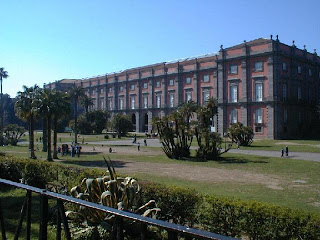
fonte: in-campania
more

-
Engl - Les Ballets Jazz de Montrèal in 9 august, Ravello
Aszure Barton draws inspiration from the forthright personalities of her dancers, and leaves them room to display their talent, so that the essence of the performance derives from an individual exploration of the artistic experience. Her choreography involves combining her approach with the habits and personal styles that she has observed in the performers. This production takes a collective approach to the theme of courage. It plays on the force of the group, and also on the refusal of an individual to submit to constrictions imposed by the tribe. The quest for and affirmation of the self cannot come about unless each individual finds the courage to take the first step. Formed in 1972, BJM Danse owed its existence to Geneviève Salbaing, with the support of co-founders Eva Von Gencsy and Eddie Toussaint. The current Artistic Director Louis Robitaille, appointed in 1998, has created a showcase for new talents and a new generation of choreographers, notably the two that have been in residence with the company, Crystal Pite and Aszure Barton. Among collaborators we can mention Patrick Delcroix, Dominique Dumais, Nicolo Fonte, Shawn Hounsell, Trey McIntyre, Mia Michaels amd Rodrigo Pederneiras. Aszure Barton is Artistic Director of Aszure & Artists, founded in 2002. She has created choreographies for such artists and dance companies as Mikhail Baryshnikov, Hell's Kitchen Dance, Benjamin Millepied & Company, Hubbard Street @, Transitions Dance Company, The Juilliard School and BJM Danse. She is currently artist in residence at the Baryshnikov Arts Center, New York.
fonte: ravellofestival
more

-
Engl - Ferragosto Maiorese from 5th to 17th August 2009, Maiori
Cristians are very devoted to the Madonna. Maiori, in particular, has the privilege to venerate S. Maria a Mare, Maiorese honour since centuries. Since the day Maioresi fishermans found the statue of the Virgin in the sea, our Lady intercessed many times to God for Maiori. Our fathers choosed the 15th August as her fest to celebrate her Assumption in soul and body to the sky. Ferragosto is a elation day, and the song of Maiorese people join to Angels songs. Everybody today we look at the sky and next to S. Maria a Mare we feel above the world shallowness and we address hour hearts to something saint.
fonte: proloco.maiori.sa
more

-
Engl - The Sounds of the Gods from 6 may to 28 october 2009, Praiano
"I Suoni degli Dei "(the Sounds of the Gods) is an event born from an idea of the association Pelagos and council of Praiano.It is the first event of this type for the Amalfi Coast and the Regional Park of Monti Lattari. Amoungst the first performances, national and international musicians will perform along the most beautiful walking path in the world, il Sentiero degli Dei. In spring 2008 the performances will be each Wednesday during May. The autumn performances will be Wednesdays throughout September and October. The theme of the project is to unite the passion of music and love of the environment in a series of concerts of both classical and contemporary music, in such unforgettable places as the amazing peaks of monti Lattari, the wonderful surroundings of the church of Santa Maria a Castro, and ancient stone ruins. Each performance will begin with an excursion on foot from Praiano, Agerola and Positano to reach the Sentiero degli Dei, a natural theatre suspended high above the Punta Campanella and the Isle of Capri. The performances will come to life in the morning hours, or towards sunset.There will also be some magical night performances under the full moon.This will be a new and different way of hiking, in which one will be in intimate harmony with nature and music.
Wednesday May 6, 2009 at 10.00 am - Convento di Santa Maria a Castro
E. Morricone Gabriel's Oboe
G. Paisiello Nel cor più non mi sento
F. Durante Danza danza
A. Scarlatti Sento nel core
P.Porro Le saule des malheureux -La serenade- Canzonetta
M. Giuliani Le dimore amor non ama - Quando sarà quel dì
P.Porro Chant d'une jeune arabe - L'adieu - L'Amour marchand de co
F.Schubert Schäfers Klagelied Heidenröselein
V. Bellini Ma rendi pur contento - Vanne o rosa fortunata
Anonimo Lu Cardillo - Fenesta vascia
MARIA COLLINA soprano
MARIA GARGIULO flauto
LUIGI TALAMO chitarra
Sunday May 10, 2009 at 10.00 am - SENTIERO DEGLI DEI li Cannati
H. Villa- Lobos Preludio n°5 -Bachianas Brasileiras
F. Carulli Serenata
A. Piazzolla Libertango - L' histoire du tango, Cafè 1930
S. Tanley Myers Cavatina ( tim from deerhunter )
J. Ibert Entr'acte
C. Machado Paçoca - Piazza Vittoria - Quebra queixo
MARIA GARGIULO flauto
LUIGI TALAMO chitarra
Wednesday May 13, 2009 at 10.00 am - SENTIERO DEGLI DEI Colle Serra
E.Grieg Il mattino
M. Giuliani Dance n3 (da "Northern Dance Op.14")
J. F. Handel Suite - Minuetto - March - Little Fugue - Bourèe (da "The Royal FireWorks Music") - Sarabanda - Gavotte - Festival March
J. S. Bach Chorale BWV 140
J. Porret Edipo - Petrarca
J. De Haan Brezza leggera
A. Waignein Dream Theme - Ky Mition - Nick's Rag
STEFANO D'URSO tromba
DANIELE LUCIBELLO tromba, flicorno
GIUSEPPE TALAMO trombone
Wednesday May 20, 2009 at 10.00 am - SENTIERO DEGLI DEI li Cannati
C.W. Gluck La danza degli spiriti beati
G. Faure' Pavane op.50
S. Mercadante Duetto quinto dai sei duetti concertanti
MARIA GARGIULO flauto
MARIA RAUSO flauto
Wednesday May 27, 2009 at 10.00 am - Convento di Santa Maria a Castro
B. Galuppi Concerto
L. W. Beethoven Serenata Opus 41
Anonimo Tarantella siciliana
GIOVANNA MORO violino
ANTONIETTA DE CHIARA violino, viola
MARIA RAUSO flauto
MARIA GARGIULO flauto
Tuesday July 7, 2009 at 10.00 pm
NOTTI DI LUNA PIENA (NIGHTS OF THE FULL MOON)
Convento di Santa Maria a Castro
Saturday July 18, 2009 at 09.00 pm
Speciale "i Suoni degli Dei"
LUDOVICO EINAUDI
"the solo concert"
Convento di Santa Maria a Castro
Wednesday July 29, 2009 at 10.00 pm
"i Suoni della Tradizione" 9° Festival della Tradizione (FOLK SOUNDS)
Piazza San Luca
FANFARE CIOCÅRLIA
Thursday August 6, 2009 at 10.00 m
NOTTI DI LUNA PIENA (NIGHTS OF THE FULL MOON)
Convento di Santa Maria a Castro
Monday August 10, 2009 at 10.00 pm
"i Suoni della Tradizione" 9° Festival della Tradizione (FOLK SOUNDS)
Piazza San Luca
AMBROGIO SPARAGNA & Orchestra Pizzicata
TARANTA D'AMORE
Friday August 21, 2009 at 10.00 pm
"i Suoni della Tradizione" 9° Festival della Tradizione (FOLK SOUNDS)
Piazza San Luca
CANTORI DI MONTE SANT'ANGELO
'NFANNE 'NFANNE
Friday August 28, 2009 at 05.00 pm
"i Suoni della Tradizione" 9° Festival della Tradizione (FOLK SOUNDS)
Grotta di Suppraiano
RAFFAELLO SIMEONI
MATER SABINA
September 2-6-9-16-23-30 2009
October 4-7-14-21-28 2009
fonte: amalficoast
more

-
Engl - Maiori
Maiori lies at the head of the Tramonti valley and is said to have been founded by the Etruscan Lucumone Rehginna, whose name was given to both the stream that divides the town (Reghinna Major) and the main road (Corso Reghinna). In more recent times Maiori became known in the media because it became the favorite set of the famous director Roberto Rosellini, for the production of "Paisà" in 1946, "Il Miracolo" (the second part of the film "L'Amore") in 1948, "La macchina ammazzacattivi" in 1952 and "Il Viaggio in Italia" in 1953. Nowadays, during the "Rossellini film festival" Maiori turns into a film set, where budding directors screen short films that are subsequently judged by an expert jury. The cultural and gastronomical events most of all take place during the high season: "Maiori: vicoli e cultura" (Maiori: lanes and culture), "La maratona delle cinque chiese" (The five-church-marathon", celebrations that take place in various districts, as well as theatrical and musical performances by artists from Maiori.
Gastronomy
Maiori uses all of the typical elements in its gastronomic tradition made by using local agricultural products joined together the fish from the waters of the Tirreno Sea. Naturally, the characteristic recipes of Maiori may differ since they are based on original family dishes passed down from generation to generation. Some examples of the local cuisine are the unusual combination of Eggplants with a chocolate and nut sauce; a sweet delicacy that may have its roots in the middle east culture, one of many cultures which ruled on the Campania coast in past centuries. We also include the recipe for Liquore Concerto, prepared using a recipe kept secret for many years, and which still today is rarely shared.
Monuments
Collegiate of S. Maria a Mare
Church of S. Francesco
Church of the "Avvocata"
Abbey of S. Maria De Olearia
Castle of S. Nicola de Thoro-Plano
Mezzacapo Building (Municipal seat)
Bulwark of S. Sebastian
fonte: amalficoast
more

-
Engl - Amalfi Coast, “La Divina”
The landscape is made of sea and mountains, with creeks and coves often attainable only by sea, such as for example the wonderful cave, grotta dello Smeraldo in Conca dei Marini and Furore fiord. In some areas nature is completely uncontaminated. The area is occupied by LattariMountains, of calcareous nature: the highest mountain is Monte S. Angelo a Torre Pizzi (1425 m). The Coast is characterised by the typical cultivations on the terraced land where the most important product is lemon and other citruses. Lemons are mostly sweet; they can also be eaten in slices, as a dessert, with or without sugar. A legend tells that the inhabitants of Minori convinced the Pope to give them back the bishopric giving him as a present a basket with lemons and other citruses. Lemons are used for cakes and to make the "limoncello", a traditional yellow liqueur famous all over the world.
fonte: costadiamalfi
more

-
Engl - Sorrento
Sorrento is on a tuff rock over the sea and dominates the horizon. On the top of the rock, the green shadows of vegetation mix with the colours of the town of Sorrento. For ancient people, Sorrento and Sorrento Coast were the land of mythical creatures, called mermaids. Maybe the name of the town, Sorrento, comes from the word "sirenide". The indented coast is made of hidden creeks; rocks; beaches and this landscape frightened mariners in the past. Today these variegated coast is the resource of Sorrento because tourists love it. From Sorrento you can admire the isle of Capri, Ischia and the whole Gulf of Naples. The ancient part of the town still keeps its most ancient features and the Roman sign; there are still the walls built in 1500. Among the most interesting treasures of Sorrento, there is Piazza Tasso, the cathedral (of XV century), the church dedicated to Saint Francis of Assisi (with a beautiful XIV century cloister with Arabian features); Correale Museum, with its Greek and Roman objects, porcelains from Capodimonte, paintings. The small and picturesque village of anglers in Marina Grande surely deserves a visit. Sorrento is famous all over the world thanks to the popular song Torna a Surriento and Italian and foreign tourists do love it. Accommodation in Sorrento is comfortable and easy; in Sorrento you can choose the solution you need: a hotel, a bed and breakfast, a residence, or a room. Gastronomy is a great resource, thanks to the presence of typical restaurants and pizzerias, to typical products, such as limoncello, cheeses, pasta, and much more. Salami are delicious and are seasoned with orange peel. If you like wines, you should visit the local producers, where you will taste quality and tasty wines. They are perfect for a typical meal: 'gnocchi alla sorrentina', 'spaghetti alla sorrentina', fish. Sorrento is the main town of Penisola Sorrentina, a territory whose great resource is natural beauty. Penisola Sorrentina includes also other towns, such as Vico Equense (the sea is crystalline and there is an interesting museum dedicated to minerals); Massa Lubrense, with its picturesque hamlets, such as Nerano and Sant'Agata sui Due Golfi (between the two gulfs, Naples and Salerno); Punta Campanella, a beautiful marine reserve; Castellammare di Stabia is famous for the thermal baths and for excavations (together with Pompeii and Ercolano); Piano di Sorrento has beautiful tuff palaces; Sant'Agnello is a picturesque territory whose main products are citruses; Meta di Sorrento has a precious basilica dedicated to Madonna del Lauro. The inner part of the territory is interesting, too: for example Agerola; Pimonte, the village situated "apud montes"; Lettere; Gragnano famous for its most typical product, pasta. Sorrento has a strategic geographic position, not far from the most interesting towns and tourist places of Campania. Amalfi Coast is part of the same peninsula but it is on the Gulf of Salerno. So staying in Sorrento means the possibility to reach easily the famous towns of Amalfi Coast, for example the town of fashion, Positano; the town of music, Ravello, and the wonderful Amalfi. But also the other towns of Amalfi Coast are not far from Sorrento Coast, for example Praiano, Furore, Conca dei Marini, Minori, and Maiori. The excavations of Pompeii and Cilento Coast can be easily reached, too.
fonte: costasorrentina
more

-
Engl - The Eruption of Vesuvius
On the morning of August 24, A.D. 79, a great noise was heard in the area around Vesuvius. A mushroom shaped cloud of gas and volcanic rock rose high in the air, darkening the sky. A shower of burning cinders and rock fragments covered Pompei. It lasted until the next day, caving in roofs and claiming its first victims. The Pompeians tried to take shelter in the houses or hoped to escape by walking on top of the layers of pumice stones constantly being formed, which by this point were more than 2 meters deep. But at dawn on August 25, a violent explosion of toxic gases and burning cinders devastated the city. It infiltrated everything, taking those who were trying to flee by surprise and making every form of defense vain. A shower of very fine ash was deposited everywhere to a depth of more than six meters, enveloping everything and adhering to the forms of the bodies and even the folds of their clothes. When, two days later, the fury of the elements abated, the entire area had a different aspect: a white blanket covered everything; the Sarno river was trying to find its course again after having been filled with volcanic rubble; and the coast, submerged by the material spewed forth by Vesuvius, had encroached on the sea! The whole city was declared off limits, to protect the property of the survivors, but clandestine diggers tried to plunder it anyway. For a long time the human presence was rare and marginal, and only under the emperor Hadrian, around 120 A.D., was at least the road system in the area reopened to traffic. We have an eye-witness report of the catastrophe in a letter from Pliny the Younger to the Roman historian Tacitus, in which he tells about the death of his uncle, Pliny the Elder, as he was trying to bring aid to the devastated cities. If you would like to hear it, press 103 and then play.
fonte: pompeiisites.org
more

-
Engl - Positano
Positano offers the warm southern acceptance making to feel l' host like if it were to house its. Positano donates one irripetibile show, from the natural beauties to the splendid and romantici sunsets. We advise to the kind hosts also the walks along the roads of Positano, where particular and typical storees will be able to be admired, to taste optimal freezes to you and granite of true lemon and, for the lovers of monuments, we suggest to visit Parochial of S. Maria Assunta situated in Flavio Gioia Public square, one church with maiolicata dome, to see moreover, in proximity of the church, the rests of one roman villa.
fonte: positano.starnetwork
more

-
Engl - History of Amalfi
The origin of the town is not a certain one. The name comes from Latina (from Melfi, a Lucan sea village abandoned by Roman people in IV century a.C. or maybe from Roman gens Amarfia, that lived in I century a.C.). A legend tells that the name comes from Amalfi, a nymph loved by Hercules. She was buried there as a desire of the gods. Amalfi was surely inhabited by Romans, escaped on Lattari mounts to hide from Germanic and Longobard invasions. It was a castrum in defence of Byzantine ducat of Naples. The town had a privileged relation to Byzantium thanks to its ability in the commerce. Amalfi people invented the compass and spread its use in the Mediterranean sea in the first half of XIII century. The famous "mythic" inventor Flavio Gioia never existed even if a monument in the main square of Amalfi was dedicated to him by an artist from Cava de' Tirreni, Alfonso Balzico. An ancient Amalfi tradition tells that a man, Giovanni Gioia, was the person who invented the compass. Sailors from Amalfi were able to manage commercial relations to all the towns of Mediterranean Sea, also to Saracens. Amalfi has been an Episcopal seat since 596. On the 1st September 839 Amalfi separated from the Ducat of Naples and became an autonomous town. Longobard princes had always been interested to conquer this rich town, but Amalfi was able to resist. The small autonomous state was governed by a count, elected each year by representatives from the noble families and then it was governed by a duke. During that period the state covered the area between Cetara and Positano, together with Capri and Li Galli isles, and in the inner part it included also Lattari mounts to Gragnano, near Naples. This was the best period for Amalfi: this was also the period of the rivalry with Pisa, Genoa and Venice. Amalfi had its own currency: the tarì. Commerce was very prosperous and merchants had colonies in many places on the Mediterranean Sea. There was the institution of the maritime law code, too. It was called "Tavola amalfitana" (it is kept as a paper copy of XVII century in the Museo Civico). In 1039 Guaimario V, Prince of Salerno, subdued Amalfi for a short while. Then Roberto il Guiscardo started its domination in Southern Italy. To survive, Amalfi had to ask for its protection and the last duke of Amalfi, Marino Sebaste, was removed. The Pope formed an alliance against Roberto il Guiscardo and the Pisani, that were part of this alliance, in 1135 sacked Amalfi and the near towns. Amalfitana Coast was now a feud governed by several different noble families. It had lost its wealth and its power. In 1131 it had been conquered by Ruggiero II, the Norman king. He protected Amalfi and its commerce that represented a very important resource for the Reign of Sicily. But in 1135 Pisani came again to Amalfi and destroyed it, while its navy was fighting against Saracens. Amalfi commercial power completely declined also because of anti-Byzantine politics of Norman rulers: Amalfi could no more trade with Byzantine towns, but only with the ports of Southern Italy. During Middle Ages Amalfi had powerful fleets: a military navy and a commercial one. The military one was very strong and defeated many times Arabs, for example in the famous battle of Ostia (849) when Amalfi navy contributed to the defence of Rome against Muslims. Amalfi built its ships in an arsenal whose ruins still remain. It is now the only survived arsenal in Southern Italy. It was restructured in 1240 and 1272. Commercial ships were built on the beaches, called for that reason with the Byzantine name of "scaria". In the night between 24th and 25th November there was a terrible landslip that submerged the port. It was provoked by a terrible Libeccio storm. In 1398 Amalfi became a feud of Sanseverino family, then of Colonna, Orsini and Piccolomini families. In XV century Amalfi was ruled by Aragons and there was the arrival of Catalan merchants that were in competition with the local ones. This was another period of decadence. In 1643 there was a terrible and cruel plague, a third of the population died. The coast became more and more miserable. In XVIII century Amalfi was almost uninhabited, the noble families had moved to Naples. But in this period there was the naissance of new handicraft activities: the "centrellari", that built rivets in Pogerola, the coral-workers, the goldsmiths, the blacksmiths and the "calafati" (the workers that repaired the ships to make them waterproof). In June 1807 Giuseppe Bonaparte visiting the Coast was enchanted by it and decided to build a road from Naples to Amalfi. The road was completed in 1854 by Ferdinand II. In 1879 the famous writer Erik Ibsen, walking through the narrow streets of the Coast, had the right inspiration to complete his masterpiece "A doll's house". In XX century Amalfi became a famous tourist destination, the "dolce vita" arrives from Rome to Capri and Amalfi: film directors, artists, actors and actresses came to this Coast.
fonte: amalfi.it
more

-
Engl - Auditorium Parco della Musica
Designed by Renzo Piano, the new Auditorium Parco della Musica is a huge cultural hub located in Rome's Flaminio district. It features three concert halls and an open-air arena, each designed with different acoustic-enhancing characteristics to suit various music genres. Surrounded by a sea of vegetation that leads to the adjacent Villa Glori, the Auditorium Parco della Musica comprises the 2800-seat Santa Cecilia Hall, ideal for large orchestral and choral symphonic concerts, the 1200-seat Sinopoli Hall (named after the Italian composer and conductor who died in 2001) and the Petrassi Hall, which hosts contemporary music and theatre performances as well as cinema. But that's not all, the structure is also home to three studios, an archaeological museum, displaying findings that were recovered during excavation works, and the Cavea, the Auditorium Parco della Musica outdoor arena which can hold up to 3000. The Hanging Garden, a 38 square metre outdoor area is the ideal chill out zone after frenetic concert-going. The venue also hosts dance performances, festivals, literary events and permanent and temporary art exhibitions, which take place in the newly built Auditorium Arte. Please visit the Auditorium Parco della Musica website for programme details.
fonte: whatsonwhen
more

-
Engl - Colosseum
The Colosseum offers an unrivalled insight into life in ancient Rome. This stadium, which seated 50,000 people, dominates the historic centre. Crowds came to watch brutal gladiatorial contests, naval battles and the slaughter of wild animals. Rome's Colosseum enjoyed an overhaul for the year 2000, with part of the long-gone floor being reinstalled to allow events to take place. Construction work on the elliptical stadium began in around 72AD under the orders of Emperor Vespasian and was completed eight years later. Vespasian's son Titus ordered 100 days of games to commemorate the opening of Rome's Colosseum (film buffs will note that this fact was slotted into the script for Ridley Scott's Gladiator). The building itself was erected on the former site of Nero's villa and takes its name not from its own sheer size but from the massive statue of Nero which stood alongside. Rome's Colosseum is built from soft tufa brick with a marble exterior. The original design incorporated three storeys, the fourth added later in 230AD. A close look at the three older tiers reveals the traditional trick of classical Roman architecture - Doric columns are used for the lowest level, Ionic for the second and Corinthian on the third. The eye travels up from the heavier Doric base to the more intricate styles above, giving an impression of lightness unusual in such a huge building. For online bookings and other information on the Colosseum, please visit the Pierreci website.
fonte: whatsonwhen
more
